

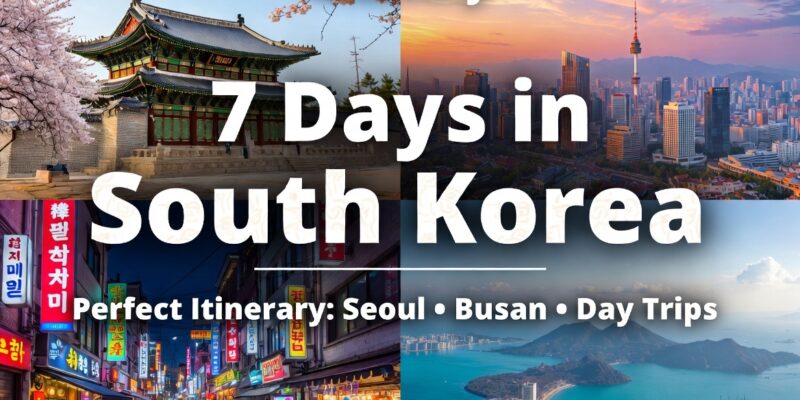
Planning a 7-day South Korea itinerary is one of the best decisions you can make as a first-time traveler to East Asia. South Korea blends ancient palaces, ultra-modern cities, scenic coastlines, and a vibrant pop culture scene into a compact, highly accessible destination. Whether you are visiting for the first time or returning after years of dreaming about Korea through K-dramas, this guide gives you a carefully planned, day-by-day South Korea 7-day travel itinerary that covers the most essential places, local food experiences, transport tips, and practical information.
This guide has been written specifically keeping Indian students and travelers in mind. If you are already exploring options to study in South Korea or looking to understand Korean culture more deeply before making that move, a 7-day trip to South Korea is the perfect starting point.
Why 7 Days is the Ideal Duration for a South Korea Trip
Seven days in South Korea gives you enough time to explore the capital city Seoul in depth, take at least one overnight trip to Busan or Gyeongju, and still have a buffer day for day trips, shopping, or rest. South Korea is a small country geographically, and its high-speed train network (KTX) connects major cities in under three hours, making it entirely feasible to cover a lot of ground without wasting travel time.
A week-long South Korea trip also aligns with most Indian students’ vacation schedules, exchange program breaks, and visa durations. If you are currently researching how to make the most of your time in Korea while enrolled in a university, check out the K-Culture section on studyinsouthkorea.in for deeper cultural insights.
South Korea 7-Day Itinerary Overview
Here is a quick snapshot of how this 7-day Korea travel plan is structured:
- Day 1: Arrival in Seoul, Incheon Airport orientation, Myeongdong check-in
- Day 2: Historic Seoul — Gyeongbokgung Palace, Bukchon Hanok Village, Insadong
- Day 3: Modern Seoul — Gangnam, Lotte World Tower, Han River
- Day 4: Day Trip to the DMZ or Nami Island
- Day 5: Travel to Busan — Gamcheon Culture Village, Haeundae Beach
- Day 6: Busan Deep Dive — Jagalchi Fish Market, Haedong Yonggungsa Temple, BIFF Square
- Day 7: Return to Seoul, Final Shopping, Departure
Day 1: Arrival in Seoul and First Impressions of South Korea
Getting from Incheon International Airport to Seoul City Center
Your South Korea itinerary begins the moment you land at Incheon International Airport (ICN), one of the most efficiently run airports in the world. From the airport, the most affordable and convenient way to reach central Seoul is the Airport Railroad Express (AREX), which connects to Seoul Station in approximately 43 minutes. The all-stop train takes about 66 minutes and is considerably cheaper.
Upon arrival, your first priorities should be:
- Purchasing a T-money card (a rechargeable transit card used for metro, buses, and some taxis throughout South Korea)
- Activating your Korean SIM card or renting a pocket Wi-Fi device (available at the airport)
- Exchanging currency — South Korean Won (KRW) is the local currency, and ATMs at the airport accept most international cards
Where to Stay in Seoul for Your First Visit
For a 7-day South Korea trip, it makes sense to base yourself in central Seoul for the first four days. The neighborhoods of Myeongdong, Hongdae, and Insadong offer affordable accommodation, easy access to metro lines, and are surrounded by food, nightlife, and culture.
Myeongdong is especially popular among first-time visitors from India because of its proximity to shopping streets, a wide range of budget to mid-range guesthouses, and the convenience of having everything walkable. Hotels here range from budget hostels at around 25,000 to 40,000 KRW per night to comfortable 3-star hotels at 80,000 to 150,000 KRW.
Evening: Exploring Myeongdong Street Food on Night 1
After checking in and freshening up, spend your first Seoul evening walking through Myeongdong’s famous outdoor street food corridor. This is one of the best introductions to Korean street food culture and is particularly welcoming for Indian vegetarian travelers as well, since vendors often separate meat and vegetable options clearly.
Try the following on your first evening in South Korea:
- Hotteok (sweet pancakes filled with brown sugar and nuts)
- Tteokbokki (spicy rice cakes — note these are vegetarian but contain fish cake in traditional versions, so ask vendors)
- Korean corn dogs with various coatings
- Fresh fruit juices and yogurt smoothies
Myeongdong is also home to some of the best skincare and cosmetic brands in Korea. If K-beauty products are on your shopping list, this is a good time to browse without pressure.
Day 2: Historic Seoul — Palaces, Hanok Villages, and Traditional Culture
Morning: Gyeongbokgung Palace and the National Folk Museum
Start Day 2 of your South Korea 7-day itinerary early. Gyeongbokgung Palace opens at 9:00 AM (closed Tuesdays) and receives enormous crowds by mid-morning, so arriving right at opening time gives you the best experience.
Gyeongbokgung is the largest and most iconic of Seoul’s Five Grand Palaces. Built in 1395, it served as the main royal palace of the Joseon Dynasty. The scale of the compound is genuinely impressive, and walking through the main gate (Gwanghwamun Gate) into the palace grounds gives you an immediate sense of Korea’s rich dynastic history.
Key sights within the palace complex:
- Geunjeongjeon (Throne Hall): the central ceremonial hall where kings held court
- Gyeonghoeru Pavilion: a stunning two-story pavilion set on a stone island in a lotus pond
- Hyangwonjeong Pavilion: a smaller, more intimate garden pavilion in the northern section
- National Palace Museum of Korea: located within the compound, free entry, excellent exhibits on Joseon history and royal artifacts
- National Folk Museum: also within the grounds, covers everyday life in Korea across centuries
Budget about two to three hours for the palace and museums combined. Entry to Gyeongbokgung costs 3,000 KRW for adults. If you wear traditional Hanbok clothing (which can be rented near the palace entrance for 10,000 to 20,000 KRW), entry is free.
Afternoon: Bukchon Hanok Village and Insadong
After the palace, walk northeast about 15 minutes into Bukchon Hanok Village. Bukchon is a residential neighborhood of traditional Korean wooden houses (hanok) that has been preserved amidst the urban sprawl of modern Seoul. Walking through the winding lanes here gives you one of the most photographed views in all of South Korea: a hillside of grey-tiled hanok rooftops with the Seoul skyline in the background.
A few things to be mindful of in Bukchon:
- This is a functioning residential neighborhood, not a museum. Noise should be kept to a minimum.
- Photography is welcome on the public streets, but do not photograph private homes or enter private courtyards.
- Several hanok have been converted into traditional tea houses, craft workshops, and small guesthouses. Stopping for a cup of traditional barley tea (boricha) at one of these establishments is a memorable experience.
From Bukchon, head south to Insadong, Seoul’s traditional arts and crafts district. The main pedestrian street is lined with galleries, antique shops, calligraphy studios, and tea houses. For Indian students interested in Korean cultural arts, this neighborhood connects well to the broader K-Culture programs and experiences that many Korean universities incorporate into campus life.
Insadong is also home to Ssamziegil, a uniquely designed open-air shopping complex built around a spiral walkway, housing independent boutiques, craft stalls, and cafes.
Evening: Cheonggyecheon Stream Walk
End Day 2 with a leisurely walk along Cheonggyecheon Stream, a beautifully restored urban waterway that runs for about 5.8 kilometers through the heart of Seoul. The stream is lit attractively after dark and is a favorite spot for both locals and tourists to decompress after a day of sightseeing.
Day 3: Modern Seoul — Gangnam, Lotte World Tower, and the Han River
Morning: Gangnam District and the Coex Mall Complex
Day 3 of your 7-day South Korea trip takes you into the ultramodern side of Seoul. Start your morning in Gangnam, the upscale commercial and entertainment district made internationally famous by the K-pop song of the same name. Beyond the song, Gangnam is actually one of the most important business and cultural districts in Seoul, home to major entertainment agencies, luxury retail, and some of the city’s finest restaurants.
The Coex Mall in Gangnam is a massive underground shopping and entertainment complex that deserves at least an hour of your time. Within Coex, the Starfield Library stands out as a genuinely extraordinary space — a two-story public library inside the mall with towering bookshelves and open seating. It has become one of Seoul’s most photographed architectural interiors and is worth visiting even if you have no interest in shopping.
Near Coex, the Bongeunsa Temple offers a surprisingly peaceful contrast: a Buddhist temple founded in 794 CE that now sits directly adjacent to skyscrapers and high-end hotels. The temple is free to enter and offers evening templestay programs for those interested in a deeper cultural experience.
Afternoon: Lotte World Tower and Observation Deck
Take the metro to Jamsil station to visit the Lotte World Tower, one of the tallest buildings in the world at 555 meters. The observation deck on the 117th to 123rd floors (called Seoul Sky) offers panoramic views of the entire Seoul metropolitan area and on clear days, you can see as far as Incheon to the west. Admission costs approximately 27,000 KRW.
Adjacent to the tower is Lotte World, one of the world’s largest indoor theme parks. If you are traveling with family or enjoy theme parks, this is worth a half-day. Otherwise, the outdoor lake area and free-to-browse shopping complex around the base of the tower are pleasant ways to spend an hour or two.
Evening: Sunset and Dinner on the Han River
Seoul’s Han River bisects the city and its riverside parks are central to daily life for Seoul residents. In the evening, head to Yeouido Hangang Park or Banpo Hangang Park to experience one of Seoul’s favorite evening rituals: buying convenience store food (from nearby GS25 or CU stores), spreading out on the grass, and watching the city skyline reflect on the water.
The Banpo Bridge Rainbow Fountain operates on a schedule during warmer months and is one of the most impressive free shows in Seoul, featuring 200 nozzles arching colored water over both sides of the bridge in synchronized patterns.
Day 4: DMZ Tour or Nami Island Day Trip
Option A: DMZ (Demilitarized Zone) Tour — For History-Minded Travelers
The Demilitarized Zone, the heavily fortified border between South Korea and North Korea, lies only about 60 kilometers north of Seoul and is one of the most historically significant and geopolitically unique places you can visit anywhere in the world. This is not a typical tourist attraction in the conventional sense — it is a sobering reminder of a conflict that technically has never ended.
Most visitors to the DMZ do so through organized tours, which typically depart from Seoul’s major hotels or the War Memorial of Korea in the morning and return by late afternoon. Tours cost between 50,000 and 100,000 KRW depending on the operator and itinerary.
Key DMZ sites included in most tours:
- Imjingak Park: a memorial park and the farthest north most civilians can travel independently
- The Third Infiltration Tunnel: one of four known tunnels dug by North Korea beneath the border, wide enough to pass tens of thousands of soldiers per hour
- Dora Observatory: an elevated observation point where visitors can look across the border into North Korea on clear days
- Dorasan Station: the southernmost station of the Gyeongui Line, which once connected Seoul to Pyongyang, now silent and symbolic
The DMZ tour is strongly recommended if this is your only trip to South Korea. The experience is intellectually and emotionally engaging and provides context for understanding contemporary Korean identity that no amount of K-drama viewing can fully replicate.
Option B: Nami Island and Garden of Morning Calm
If you prefer a more relaxed day four, the combination of Nami Island and the Garden of Morning Calm offers a scenic escape from the city.
Nami Island (Namiseom) is a half-moon-shaped river island in Chuncheon, about 75 minutes from Seoul. It became internationally famous after featuring in the K-drama Winter Sonata and has since developed into a beautifully maintained nature and arts destination. The island is known for its straight tree-lined paths, which turn golden in autumn and are particularly photogenic. Entry plus ferry costs approximately 16,000 KRW.
The Garden of Morning Calm, located nearby, is one of Korea’s largest private gardens and offers seasonal floral displays throughout the year. Combined admission with Nami Island is possible through package tickets sold at major Seoul tour counters.
Day 5: Travel to Busan and First Afternoon in the Port City
Taking the KTX to Busan
Day 5 marks the shift from Seoul to Busan, South Korea’s second-largest city and its most important port. This is where your South Korea 7-day itinerary takes on a completely different character.
The KTX high-speed train from Seoul Station to Busan Station takes approximately 2 hours and 15 minutes and costs between 59,800 and 78,700 KRW for a standard seat, depending on the train and time of departure. Booking in advance through the Korail website or the Korail app is strongly recommended, especially for weekend travel. Trains depart very frequently (roughly every 30 minutes during peak hours) so even if you miss your booking you can usually get on the next one.
Busan’s climate, landscape, and personality differ markedly from Seoul. The city is built across steep hills that meet the sea, giving it a dramatic topography that feels more Mediterranean than East Asian in places. The food culture is also distinct: Busan is considered the seafood capital of South Korea, and a trip here without visiting a fish market is incomplete.
Afternoon: Gamcheon Culture Village
Check into your Busan accommodation and head immediately to Gamcheon Culture Village, often described as the Machu Picchu of Busan due to its terraced hillside layout. Originally built as a settlement for Korean War refugees in the 1950s, Gamcheon has been transformed since 2009 through a community art project into one of Korea’s most photographed neighborhoods.
The village consists of steep, narrow alleyways lined with brightly painted houses, murals, sculptures, and art installations. Several houses have been converted into galleries, cafes, and small shops. A simple hand-drawn map available at the village entrance guides you through the main routes. Admission to the village is free; some installations charge a small entry fee.
Gamcheon is best visited in the afternoon when the light is soft and before the evening crowds arrive. The views from the upper terraces, looking out over the layered houses and down to the sea, are among the most memorable visual experiences in all of South Korea.
Evening: Haeundae Beach
Spend your first Busan evening at Haeundae Beach, the most famous beach in South Korea. Haeundae is a broad, 1.5-kilometer stretch of sand backed by a dense corridor of luxury hotels, seafood restaurants, and bars. In summer it is extraordinarily crowded (reportedly seeing up to 1.5 million visitors per day during peak season in August), but in spring, autumn, and even mild winter days it is pleasantly walkable.
The Busan Aquarium is located directly on Haeundae Beach and is worth a quick visit if you have younger travelers in your group. The Dongbaek Island (APEC House) at the western end of the beach offers good evening views of the bay.
For dinner, the street behind Haeundae Beach is lined with seafood restaurants offering fresh catch. Haemul pajeon (seafood pancakes) and raw fish platters are two of the most popular local options.
Day 6: Deep Busan — Markets, Temples, and Coastal Scenery
Morning: Jagalchi Fish Market
Wake up early on Day 6 and head to Jagalchi Fish Market, the largest seafood market in South Korea and one of the most vibrant market experiences in all of Asia. The market opens as early as 5:00 AM when fishing boats are still unloading their catch, and the lower outdoor area is a fascinating landscape of tanks, ice-packed displays, and vendors calling out prices.
The upper floors of the main Jagalchi building contain restaurants where you can buy fresh fish downstairs and take it upstairs to be cooked, or order set meals of raw fish, grilled fish, or seafood soups. This is an essential Busan experience.
Adjacent to Jagalchi is the Gukje Market, Busan’s largest traditional market, selling everything from household goods to fresh produce, street food, clothing, and Korean traditional crafts. This is a good place to buy local snacks and gifts to bring back.
Midday: Haedong Yonggungsa Temple
Take a taxi or bus north along the coast to Haedong Yonggungsa Temple, one of the most unusually located Buddhist temples in South Korea. Unlike most Korean temples, which are set in mountain forests, Haedong Yonggungsa sits directly on coastal rocks at the edge of the East Sea. The combination of Buddhist architecture, sea spray, and dramatic cliff scenery makes this one of the most visually stunning sites in Busan.
The temple complex contains several shrine halls, a 10-story stone pagoda, and a line of stone haetae (guardian animals) along the entrance path. It is particularly beautiful in early morning light, but the midday visit works well if you are balancing other Busan sights.
Entry is free. The temple is about 12 kilometers from central Busan and takes approximately 40 minutes by bus.
Afternoon: BIFF Square and Nampo-dong
Spend your afternoon at BIFF Square (Busan International Film Festival Square) in the Nampo-dong district, the historic commercial heart of Busan. BIFF Square itself is a pedestrian street paved with handprints of Korean and international film directors and actors. The area surrounding it is lively with street food vendors, cinema theaters, and small shops.
Nearby is Gukje Market (if you have not already visited it in the morning) and the Bosu Book Street, a fascinating holdover from the Korean War era when refugees set up secondhand book stalls here and the tradition has persisted for over 70 years. Even without reading Korean, this street is a unique and evocative place to wander.
Evening: Gwangalli Beach and Bridge Views
End your last full Busan evening at Gwangalli Beach. Smaller and more locally oriented than Haeundae, Gwangalli is framed by the spectacular Gwangan Bridge (also called Diamond Bridge), a twin-deck suspension bridge that lights up dramatically at night. The beach front is lined with cafes and restaurants with direct bridge views, and this is one of Busan’s most romantic evening settings.
Day 7: Return to Seoul, Last Shopping, and Departure
Morning: Gyeongju Option (For Those With Flexibility)
If your flight departs in the evening and you are open to an optional morning extension, consider stopping in Gyeongju on your way back from Busan to Seoul by KTX. Gyeongju is often called the museum without walls because it was the capital of the ancient Silla Kingdom (57 BCE to 935 CE) and is scattered with royal burial mounds, temple ruins, and UNESCO World Heritage Sites.
The Bulguksa Temple and Seokguram Grotto, located about 16 kilometers from central Gyeongju, are the most significant cultural sites. Bulguksa is one of the finest examples of Buddhist architecture in East Asia and its main wooden halls date to the 8th century. Admission is 6,000 KRW.
Gyeongju is 40 minutes south of Busan by KTX, and you can take a later KTX back to Seoul after 2 to 3 hours in the city, arriving in Seoul by early afternoon.
Afternoon in Seoul: Final Shopping and Departure Preparation
If you are heading straight back to Seoul without a Gyeongju stop, you will arrive in Seoul by midday with a few hours before airport departure. Use this time for:
- Final shopping in Dongdaemun or Namdaemun Market (both are traditional wholesale and retail markets that are very popular for clothing, accessories, and Korean food products to bring home)
- Myeongdong for last-minute Korean skincare and cosmetic purchases
- A final Korean meal before the airport — sundubu jjigae (soft tofu stew), bibimbap, or samgyeopsal (grilled pork belly) are all classic choices
Getting to Incheon Airport for Departure
Allow at least 3 hours before your international flight for airport arrival, immigration, and security. The AREX from Seoul Station to Incheon Airport Terminal 1 takes 43 minutes (express) or 66 minutes (all-stop). Terminal 2 requires an additional 6 minutes.
Incheon Airport also has a city check-in service, where you can check in your baggage and receive your boarding pass at select Seoul metro stations (Hongik University Station serves Terminal 2; check the AREX website for current city check-in counter availability). This service saves significant time and removes the stress of checking in at the airport itself.
South Korea Travel Tips for Indian Visitors
Visa Requirements
Indian passport holders require a visa to enter South Korea. The most commonly applicable visa for tourism is the C-3 short-term visit visa, which is a single or multiple-entry visa valid for 90 days with stays of up to 30 or 90 days per visit. Applications are submitted through the Korean Consulate or Embassy in India (major offices are in New Delhi, Mumbai, and Chennai).
Documents typically required include a valid passport, completed visa application form, recent passport photographs, confirmed flight itinerary, hotel bookings, and bank statements showing sufficient funds. Processing takes approximately 3 to 7 working days.
K-ETA (Korea Electronic Travel Authorization) was suspended for Indian nationals, so a full visa application is required.
Currency and Budget Planning
The South Korean Won (KRW) is the local currency. As of 2026, 1 Indian Rupee equals approximately 16 KRW, meaning expenses in Korea are broadly comparable to India in absolute terms for many categories. A mid-range daily budget in South Korea covering accommodation, food, transport, and entry fees would be approximately:
- Budget traveler: 50,000 to 80,000 KRW per day (roughly 3,000 to 5,000 INR)
- Mid-range traveler: 100,000 to 180,000 KRW per day (roughly 6,000 to 11,000 INR)
- Comfortable traveler: 200,000 KRW and above per day
ATMs in South Korea are extremely reliable and widely available. Woori Bank, KEB Hana Bank, and post office ATMs generally have the best success rates with international cards.
Getting Around South Korea
The Seoul Metropolitan Subway is one of the most comprehensive and user-friendly urban rail systems in the world, with nine major lines and signage in both Korean and English throughout. The T-money card (purchased and recharged at any convenience store or metro station) works on all Seoul metro lines, city buses, and most intercity buses.
For intercity travel, the KTX high-speed train is the gold standard. Seoul to Busan takes 2 hours 15 minutes. Seoul to Gyeongju takes about 2 hours 30 minutes. Seoul to Gwangju (for those extending beyond 7 days) takes about 1 hour 40 minutes.
Kakao T is the dominant ride-hailing app in South Korea and accepts international credit cards. It works similarly to Uber and is reliable in all major cities.
Internet and Communication
South Korea has among the fastest and most pervasive mobile internet infrastructure in the world. Options for staying connected during a 7-day South Korea trip:
- Korean SIM card with data plan: available at Incheon Airport from major carriers (SK Telecom, KT, LG U+), typically costs 20,000 to 40,000 KRW for 7 to 10 days of unlimited data
- Pocket Wi-Fi rental: available at the airport, useful for multiple devices
- International roaming: expensive but may be adequate for light users
Naver Maps is the most accurate navigation app for South Korea and is better than Google Maps for walking routes and public transit information.
Food Considerations for Vegetarians and Halal Dieters
Korean cuisine is predominantly built around meat and seafood, but vegetarian options are available and increasingly labelled in popular tourist areas. Doenjang jjigae (fermented soybean paste stew) made without meat, bibimbap without meat, japchae (glass noodle stir-fry), and most banchan (side dishes) at traditional restaurants are often vegetarian.
For halal food, Seoul has a small but growing number of halal-certified restaurants concentrated in Itaewon, Mapo, and parts of Myeongdong. The Itaewon neighborhood has several halal butchers and restaurants catering to the Muslim community in Seoul.
Best Time to Visit South Korea for a 7-Day Trip
South Korea experiences four distinct seasons, and each offers a different travel experience:
Spring (March to May) is widely considered the best time to visit South Korea for first-time travelers. Temperatures are mild (10 to 20 degrees Celsius), cherry blossoms bloom through late March and April, and the weather is generally clear and dry. This is high season, so accommodation books up quickly and prices rise accordingly.
Autumn (September to November) is the second-best season, offering cooler temperatures, spectacular foliage in orange and red across the mountains and parks, and clear skies. Mid-October is particularly beautiful.
Summer (June to August) brings hot, humid weather and heavy monsoon rainfall from late June through July. It is still a viable travel period, especially July and August when universities are on break, but be prepared for crowds and heat. Busan’s beaches are at their most energetic (and crowded) in this period.
Winter (December to February) is cold (Seoul temperatures regularly drop below 0 degrees Celsius) and occasionally snowy, but also offers some compelling experiences: ski resorts in Gangwon Province, winter festivals, and a markedly reduced tourist crowd making popular sites more peaceful.
South Korea Itinerary 7 Days: Frequently Asked Questions (FAQs)
Is 7 days enough for South Korea?
Seven days is a very good amount of time for a first visit to South Korea. You can cover Seoul thoroughly, make a meaningful trip to Busan, and include at least one day trip. You will not see everything the country has to offer in one week (South Korea’s rural regions, Jeju Island, the temple towns, and the ski resorts all merit separate trips), but you will come away with a solid grounding in Korean culture, food, and urban life.
How much does a 7-day trip to South Korea cost for Indian travelers?
A realistic estimate for a 7-day South Korea trip from India, covering flights, accommodation, food, transport, and entry fees, would be approximately:
- Budget trip: 1,00,000 to 1,50,000 INR per person
- Mid-range trip: 1,60,000 to 2,40,000 INR per person
- Comfortable trip: 2,50,000 INR and above per person
The largest cost variable is flights. Return flights from major Indian cities (Delhi, Mumbai, Bangalore, Chennai) to Seoul Incheon are typically available in the range of 30,000 to 55,000 INR with one stopover, and somewhat higher for direct flights.
Is South Korea safe for solo Indian travelers?
South Korea is consistently rated among the safest countries in the world for solo travelers, including solo female travelers. Crime rates in tourist areas are very low, the transport system is reliable and well-marked in English, and locals are generally helpful to international visitors even with language barriers. The emergency number in South Korea is 112 (police) and 119 (ambulance/fire). The Korea Tourism Organization also operates a 24-hour tourist hotline at 1330, where English-speaking operators can assist with directions, translation, and general travel queries.
Do I need to know Korean to travel in South Korea?
For a 7-day South Korea itinerary covering Seoul and Busan, you can travel very comfortably with English alone. Metro signage, major tourist sites, airport facilities, and most popular restaurants in tourist areas have English translations. That said, learning a few basic Korean phrases (annyeonghaseyo for hello, gamsahamnida for thank you, and counting numbers) is appreciated by locals and adds meaningfully to the travel experience.
What is the best way to get a Korea tourist visa from India?
Tourist visa applications for South Korea from India are submitted in person at the Korean Consulate General. Required documents include a valid passport (minimum 6 months validity), completed application form, bank statements (typically showing a minimum balance of around 1,500 USD equivalent), confirmed flight and hotel bookings, and recent photographs. Applications for the C-3 tourist visa are generally processed within 3 to 7 working days. The visa fee is approximately 3,000 INR (subject to change). Students planning to study in South Korea on a longer basis will need a D-2 student visa, which requires university enrollment documentation.
Can I use Indian credit cards in South Korea?
Yes, Visa and Mastercard are widely accepted at hotels, department stores, and most restaurants in tourist areas. However, some traditional markets, street food stalls, and smaller local restaurants only accept cash. It is advisable to carry some Korean Won in cash for day-to-day expenses and smaller vendors.
How should I plan my South Korea trip if I am also considering studying there?
Combining a tourism trip with a study exploration trip is increasingly common among Indian students. During your 7 days, consider visiting university campuses in Seoul (Yonsei University, Korea University, Sungkyunkwan University, and Hanyang University are all open to visitors during normal hours), attending a Korean language class as a day activity, or connecting with the studyinsouthkorea.in team for guidance on the next step. For detailed information on universities in South Korea for international students, scholarship programs, and admission processes, visit the full resources section on our website.
Is Jeju Island worth adding to a 7-day South Korea itinerary?
Jeju Island, a volcanic island off the southern coast of South Korea, is a popular add-on for those staying longer than 7 days. Jeju requires a minimum of 2 full days to experience meaningfully (Hallasan National Park, the lava tube caves at Manjanggul, Seongsan Ilchulbong sunrise peak, and the coastal walking trails). For a strict 7-day itinerary, Jeju is a stretch and is better saved for a follow-up trip or a 10-day itinerary. Internal flights from Seoul to Jeju take about 1 hour and cost between 20,000 and 60,000 KRW.
What Korean foods should I try during a 7-day trip?
A 7-day South Korea trip gives you enough meals to work through the most important dishes in Korean cuisine. The following should be on every visitor’s list:
- Bibimbap: mixed rice with vegetables, egg, and gochujang paste, a staple comfort food
- Bulgogi: thinly sliced marinated beef grilled at the table, one of the most accessible Korean dishes for international visitors
- Sundubu jjigae: spicy soft tofu stew with egg, one of the most warming and satisfying Korean soups
- Haemul pajeon: seafood and spring onion pancake, best eaten in Busan
- Samgyeopsal: thick-cut grilled pork belly eaten with lettuce wraps, dipping sauces, and kimchi
- Jjimdak: braised soy-glazed chicken with glass noodles and vegetables, originating in Andong
- Bingsu: shaved ice dessert with sweet toppings, ideal in warmer months
- Ddeokbokki: spicy rice cake stew, the definitive Korean street food
Final Thoughts: Making the Most of Your South Korea 7-Day Itinerary
South Korea rewards thorough preparation. This is not a destination where wandering aimlessly tends to produce the best results — the country is dense with worthwhile experiences, and a little planning goes a long way toward making sure you see the right things at the right time.
The 7-day itinerary outlined in this guide is deliberately paced to give you depth without exhaustion. It prioritizes firsthand cultural engagement over tick-box tourism, and it is structured to be genuinely useful whether you are visiting South Korea for the first time as a leisure traveler or making your first exploratory trip as someone seriously considering studying or working there.
For Indian students who are drawn to South Korea not just as a tourist destination but as a place to build their academic and professional future, studyinsouthkorea.in is your dedicated resource. From understanding how to study in South Korea after 12th grade to exploring job opportunities in Korea for Indians, the full picture of life in Korea beyond tourism is covered in detail.
South Korea is, in many ways, one of the most rewarding countries in Asia for first-time visitors. Seven days is the ideal amount of time to begin understanding why.
This guide is published by studyinsouthkorea.in — your complete resource for studying, working, and living in South Korea as an Indian student. Explore our K-Culture section for deeper insights into Korean society, language, and student life, or browse our K-Courses page for university and language program recommendations.Share